Railways

AZERBAIJAN RAILWAYS
The history of Azerbaijan Railways is closely linked to the development of the oil industry. The country’s railway history began in 1880 with the commissioning of the first railway line. January 20 is officially recognized as the date marking the establishment of railways in Azerbaijan. Initially, the Baku-Sabunchu-Surakhani railway line was used solely for transporting oil. This route became the first in the world to transport oil using tank wagons.
In 1883, the Baku-Yelizavetpol (Ganja)-Tbilisi main railway line was launched. On May 8, 1883, the first shipment of oil was transported by rail from Baku freight station, Azerbaijan’s first freight station, toward Tbilisi. Since this line was extended by the Tbilisi-Gori-Kutaisi-Poti-Batumi segment, the railway provided a connection between the Caspian and Black Sea coasts. By 1900, Azerbaijan's railway network was integrated into the railway system of the Russian Empire.
To develop the railway transportation system to international standards, the President of the Republic of Azerbaijan issued a decree on July 20, 2009, establishing the “Azerbaijan Railways” Closed Joint Stock Company (CJSC).
According to 2024 statistics, the total length of Azerbaijan's railways is 2,957.73 kilometers, with an operational length of 2,137.34 kilometers, of which 807.39 kilometers are double-track lines. Nearly 60% of the total operational length is electrified.
The freight transport capacity of the railway system is assessed based on its infrastructure capabilities. There are 122 freight stations across the country. Currently, Azerbaijan Railways’ freight wagon fleet consists of 5,795 wagons, including 426 covered wagons, 703 platforms, 800 tank wagons, 1,000 open wagons, and 788 of other types.
BAKU-TBILISI-KARS RAILWAY LINE
The Baku-Tbilisi-Kars (BTK) railway line was constructed to enhance transit transportation between Azerbaijan, Georgia, and Turkey, and to transform the Caucasus region into a key transportation corridor between Europe and Asia. Construction began on November 27, 2007, and the line was commissioned in 2017. The railway line spans approximately 850 kilometers, with 504 kilometers running through Azerbaijan, 263 kilometers through Georgia, and 79 kilometers through Turkey. The commissioning of this railway line integrated the Baku International Sea Trade Port and other infrastructure facilities, enhancing the efficiency of cargo transportation.
In 2024, following the completion of repair, reconstruction, and expansion works on the 184-kilometer section of the BTK line in Georgia, the annual freight capacity increased from 1 million to 5 million tons.
As the shortest and most reliable route linking Europe with Asia, the Baku-Tbilisi-Kars railway line holds strategic importance within China’s “Belt and Road Initiative” and strengthens Azerbaijan’s logistical capabilities within the East-West Transport Corridor.
“Azerbaijan Railways” Closed Joint Stock Company (CJSC) is the principal state entity responsible for the strategic management of the railway sector in the Republic of Azerbaijan. Its mission is to develop domestic and international transport connections, enhance the efficiency of railway services, and strengthen Azerbaijan’s competitiveness in regional and global freight transportation.
The company was established through the reorganization of the Azerbaijan State Railway, in accordance with Presidential Decree No. 383 dated July 20, 2009.
Azerbaijan Railways plays a vital role in implementing strategically significant projects aimed at expanding and reinforcing the country’s transit potential. It actively participates in key international transport corridors, including the Trans-Caspian International Transport Route (TITR) and the North–South Corridor. By supporting the development of multimodal transport solutions and logistics centers, the company aims to reduce transit times and increase the overall efficiency of freight transportation.
In line with its international expansion, ADY established a permanent representative at Xi’an Port and, in 2025, launched a container terminal with an annual handling capacity of 20,000 TEU.
On February 25, 2025, the President of the Republic of Azerbaijan, Mr. Ilham Aliyev, signed a decree on the reorganization of “Azerbaijan Railways” CJSC.
According to the decree, in order to carry out transportation operations and logistics processes in the field of railway transport more efficiently and promptly—while better meeting maritime transportation needs—“Azerbaijan Railways” CJSC was reorganized through the merger with “Baku International Sea Trade Port” CJSC.

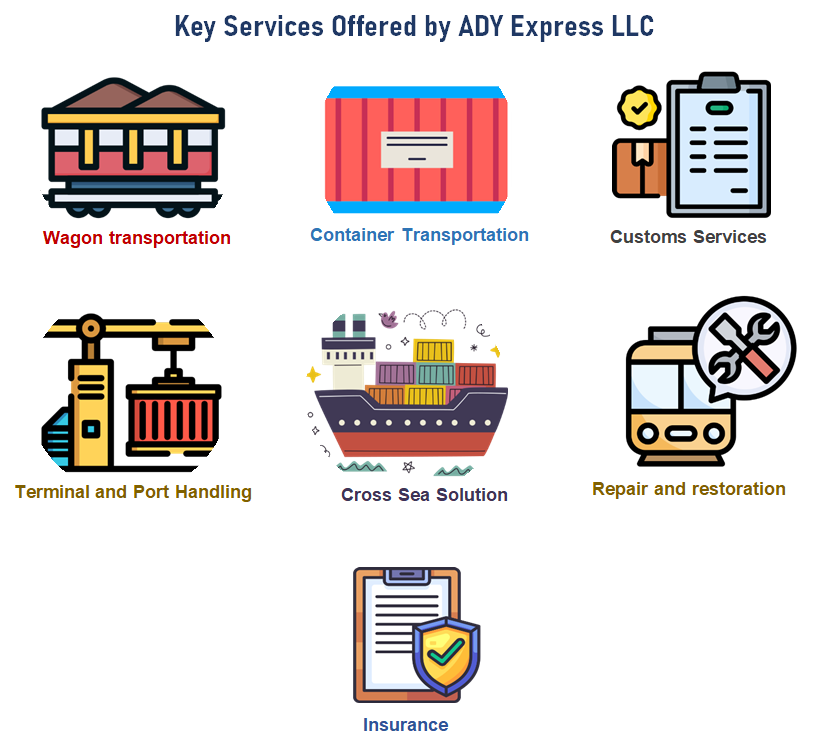
Taking into account Azerbaijan’s growing importance as a key transit country and the rising demand for rail services, “Azerbaijan Railways” CJSC established a new structural unit - “ADY Express” LLC, in accordance with international standards. Operational since 2015, ADY Express primarily provides services such as freight transportation, wagon supply, wagon repair, wagon washing, and cargo transshipment. To increase cargo volume and attract transit freight through the country, ADY Express also offers online services to freight forwarders and major cargo owners.
ADY Express uses modern technologies to ensure the safe and prompt delivery of cargo and implements automated systems to simplify logistics services. The company is actively involved in utilizing the Baku-Tbilisi-Kars railway line for efficient cargo movement.
To improve management in containerization and overall transit transportation, as of November 1, 2024, the subsidiary “ADY Container” LLC was merged with “ADY Express” LLC, thereby reorganizing ADY Express. Currently, ADY Express offers clients more comprehensive and efficient services for both container and wagon-based transportation.