
South-West Corridor
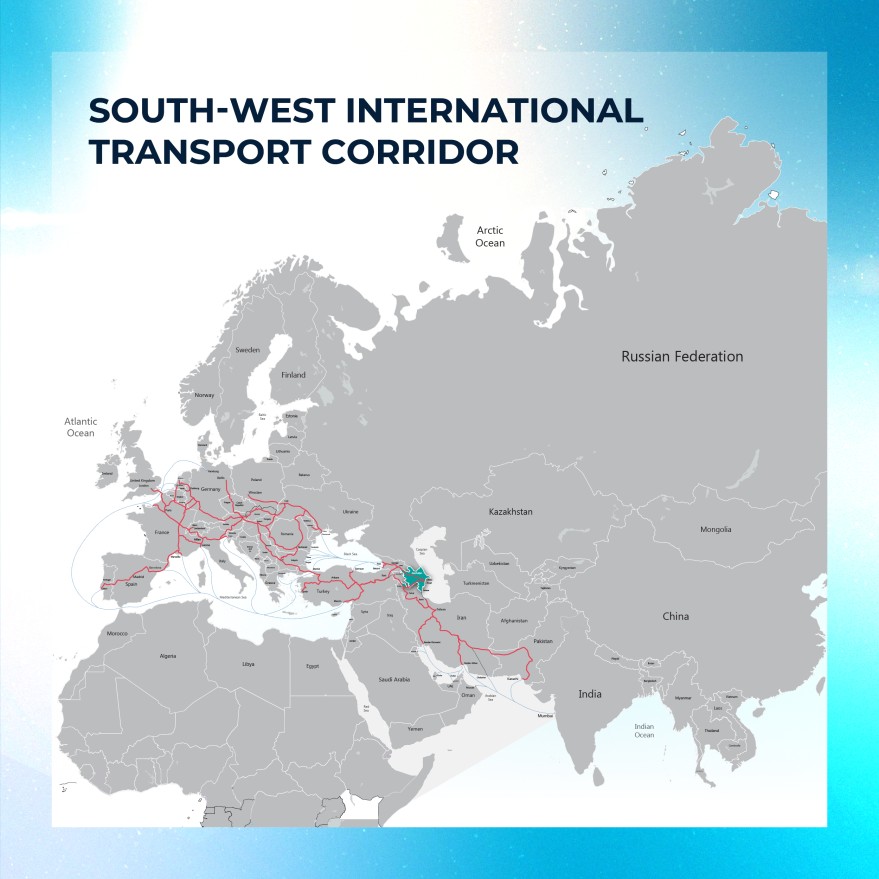
SOUTH-WEST TRANSPORT CORRIDOR
Revolutionizing Trade Between India and Europe
The South-West Transport Corridor, a key international logistics route initiated in early 2016, is transforming the flow of cargo between the Indian subcontinent and Europe. Designed to provide an efficient alternative to traditional maritime routes, this corridor passes through Iran, Azerbaijan, and Georgia, significantly reducing transit time and costs for businesses engaged in international trade.
The South-West Transport Corridor follows a geographical route from the Persian Gulf and India, traveling through Iran, Azerbaijan, and Georgia, before reaching Europe. The full corridor, officially named the Persian Gulf – Iranian Astara – Caspian Sea – Black Sea – Europe, connects major global trading regions and enhances access to crucial ports such as Bandar Abbas and the new Chabahar Port in Iran, as well as key Azerbaijani ports and rail links.
This corridor’s establishment significantly shortens the journey for goods traveling from India’s major ports, such as Mumbai and Nava Sheva, to European hubs like Rotterdam, the Baltic Sea, and Northern Europe. The reduction in transit time is one of the corridor’s most significant advantages. While traditional sea routes through the Suez Canal take around 35-37 days, the South-West Corridor slashes this to a mere 10-12 days, offering businesses a competitive edge in terms of speed and reliability.
Azerbaijan’s role is pivotal, with Azerbaijan Railways (ADY) spearheading the project and ensuring seamless integration with its national rail system. Azerbaijani logistics companies, including ADY Express LLC, are already participating in transporting cargo along this corridor, further demonstrating the country's commitment to enhancing its position as a regional transport hub.
The future potential of the South-West Transport Corridor hinges on continued infrastructure development. In particular, the timely construction of the Rasht-Astara and Qazvin-Rasht railway lines is expected to complete the corridor, enabling even greater volumes of trade, and further strengthening its position as a viable alternative to traditional maritime routes.