
North-South Corridor
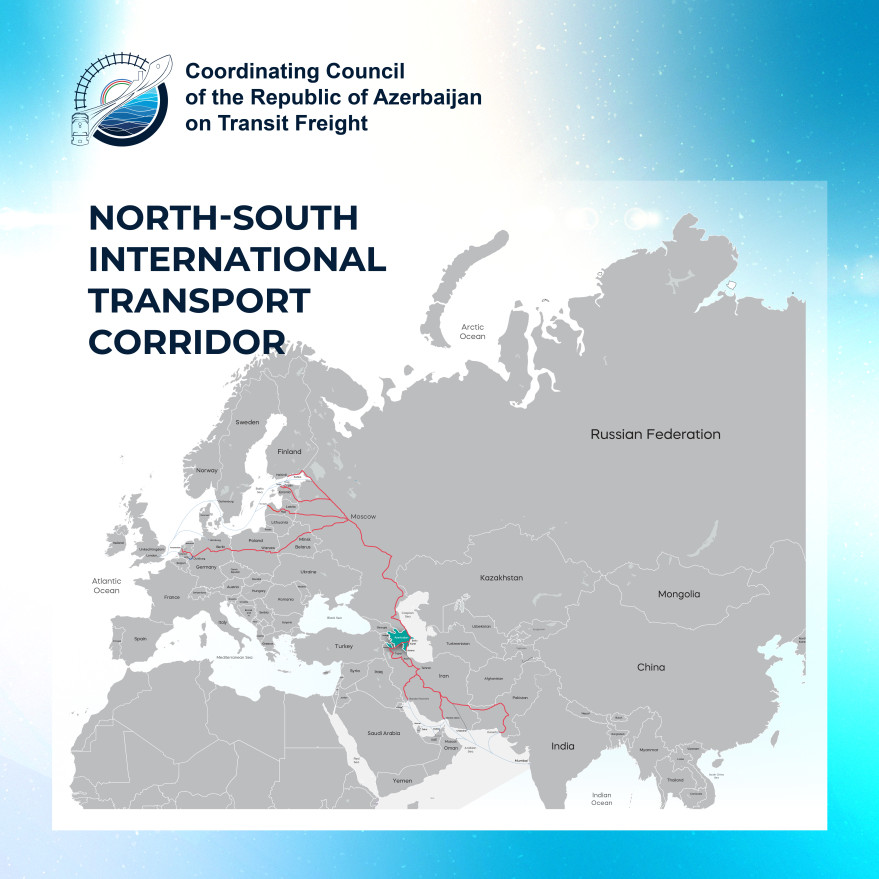
AZERBAIJAN IN THE NORTH-SOUTH CORRIDOR
The main role of the North-South corridor is transportation of goods from India and the Gulf countries, into Russia, Western Europe, the Baltic and Scandinavian countries. The main advantage of the North – South transit corridor in comparison with other routes is the reduction in the distance and delivery time of cargo transportation by two or three times. Sea freight transportation to Helsinki through the Persian Gulf – the Suez Canal – Mediterranean Sea – Baltic Sea is 45 – 60 days, while the delivery time along North – South corridor - 20 – 25 days.
The railway line of this corridor passing through Azerbaijan spans 511 km in length. Crucially, the railway segment stretching from the Azerbaijan-Russia border to the Azerbaijan-Iran border, a key component of this corridor, is now operational.The involved parties (Azerbaijan, Russia, and Iran) committed to implementing measures aimed at increasing cargo transportation along both the Northern and Southern corridors to a volume of 15 million tons (660 thousand TEU).
The infrastructure along the segment of the transport and logistics corridor traversing Azerbaijan has undergone substantial modernization, positioning the country as a pivotal link between the northern and southern regions of the Eurasian continent. Notable enhancements include the expanded capacity of the Baku Trade Seaport, the reconstruction of the Alat-Astara highway, and the construction of a new railway bridge connecting Iran and Azerbaijan. These developments have significantly augmented Azerbaijan's transit capabilities and elevated its international standing.
Azerbaijan’s Central Role in the North-South International Transport Corridor
The North-South International Transport Corridor (NSTC) is a game-changer for global trade, providing a critical route connecting India and the Gulf countries to Russia, Western Europe, the Baltic, and Scandinavian countries. This ambitious corridor significantly reduces the transportation distance and delivery time of goods, offering a much-needed alternative to traditional shipping routes. The main advantage of the North-South corridor over other routes is its ability to cut travel times by two to three times. While sea freight transportation to Helsinki via the Persian Gulf, Suez Canal, Mediterranean Sea, and Baltic Sea takes around 45 to 60 days, the North-South corridor offers a delivery time of just 20 to 25 days.
Azerbaijan’s Strategic Importance in the Corridor
Azerbaijan plays a central role in the North-South Corridor due to its location at the crossroads of key regional trade routes. The country’s railway line, stretching 511 kilometers, forms an essential part of the corridor’s connectivity, especially the critical section running from the Azerbaijan-Russia border to the Azerbaijan-Iran border. This railway segment is already operational and contributes to the smooth flow of goods along the corridor.
The transport infrastructure within Azerbaijan has seen substantial modernization in recent years, positioning the country as a pivotal link between the northern and southern regions of Eurasia. Azerbaijan's strategic investments have led to notable developments, such as the Baku International Sea Trade Port significantly enhanced its capacity to handle growing cargo volumes. Additionally, the reconstruction of the Alat-Astara highway and the construction of a new railway bridge connecting Iran and Azerbaijan have bolstered the country’s transit capabilities, making it a critical player in the success of the NSTC.
Regional Cooperation and Growth
The countries involved in the North-South Corridor—Azerbaijan, Russia, and Iran—have committed to increasing cargo transportation along both the Northern and Southern corridors.
Through enhanced cooperation, improved infrastructure, and seamless connectivity, Azerbaijan has become a key transit hub for goods traveling from South Asia and the Middle East to Europe and beyond. The modernization of transport and logistics networks in the country has not only elevated Azerbaijan’s role in international trade but also solidified its standing as a critical trade partner and logistics hub in Eurasia.
Future Prospects
The North-South Transport Corridor holds immense potential for reshaping regional trade, and Azerbaijan is poised to reap the benefits of this transformative project. As the infrastructure continues to develop and capacity expands, Azerbaijan’s role in facilitating efficient, cost-effective, and timely transportation of goods will continue to grow, positioning it as a leader in the global logistics network. This corridor with Azerbaijan at its core, promises to enhance economic connectivity, foster regional cooperation, and contribute to the broader integration of Eurasian economies into the global marketplace.