
Lapis-Lazuli Corridor
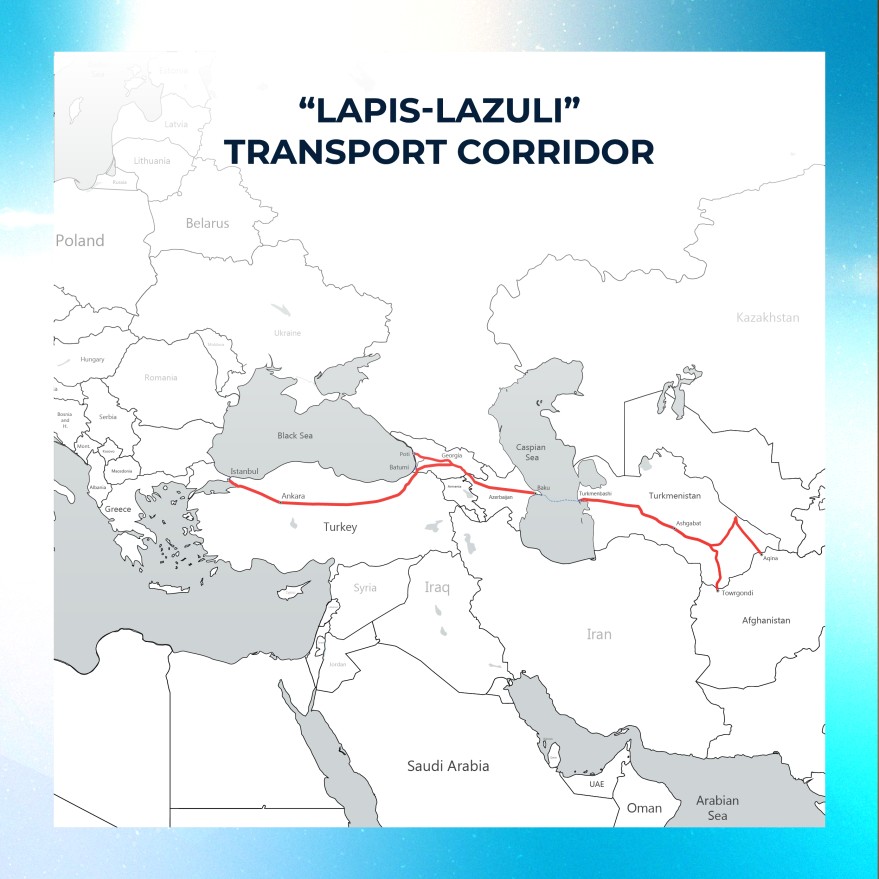
LAPIS LAZULI CORRIDOR
The Lapis Lazuli Corridor established under an agreement between Azerbaijan, Afghanistan, Turkmenistan, and Türkiye, facilitates the transportation of goods, particularly from Central Asia to Europe.
The name "Lapis Lazuli" is inspired by the precious gemstone that has historically been traded along the route, representing the cultural and economic ties between the regions. The route links Afghanistan, Turkmenistan, Azerbaijan, and Türkiye, connecting the key markets of Central Asia with Europe through Azerbaijan’s strategic port of Baku, its rail and road networks, and the Caspian Sea. The agreement for this corridor was signed in 2017, driven by the recognition of the need to open new, reliable, and safe trade routes that bypass traditional, often volatile, routes in the region.
Azerbaijan stands at the heart of the Lapis Lazuli Corridor, leveraging its position between the Caspian Sea and the Caucasus region. The country’s geographical location allows it to act as a natural bridge between the landlocked Central Asian countries and the European market.
Azerbaijan’s participation in the Lapis Lazuli Corridor offers multiple economic benefits. First, the corridor opens up new trade opportunities for Azerbaijan, increasing its exports, particularly in non-oil sectors such as agriculture, textiles, and industrial products. It also enables Azerbaijan to position itself as a regional transport and logistics hub, attracting investment in infrastructure and technology.
The expansion of transit routes through the Lapis Lazuli Corridor boosts Azerbaijan's service industries, including transport, logistics, customs, and warehousing.
Moreover, the corridor offers the potential for Azerbaijan to engage in regional economic cooperation, particularly with Turkmenistan and Afghanistan, whose economic development can benefit from direct access to global markets. The corridor can also contribute to regional stability by promoting greater economic interdependence. As the global demand for more diverse trade routes grows, the Lapis Lazuli Corridor will undoubtedly become a critical asset in the evolving landscape of international commerce.