
Zangezur Corridor
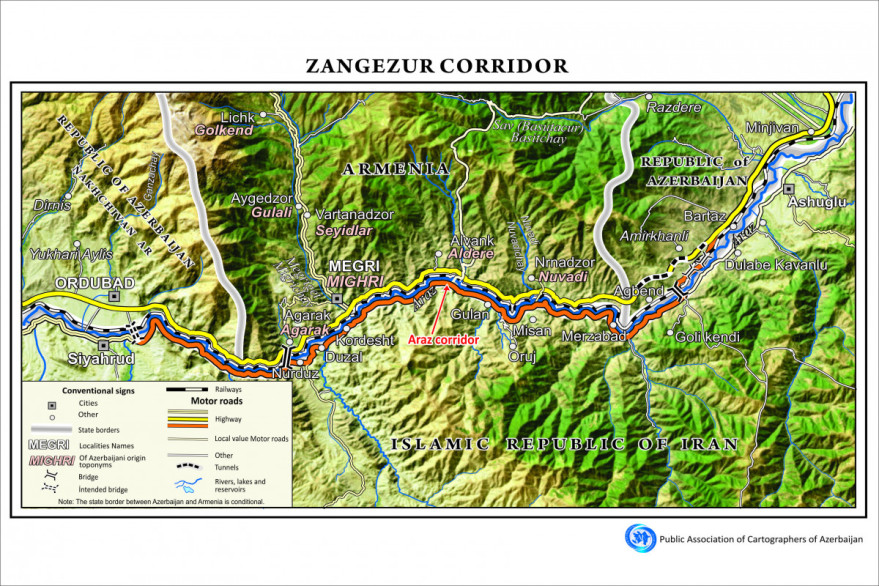
On August 8, 2025, a Joint Declaration was signed in Washington, D.C., following a trilateral meeting between the President of the Republic of Azerbaijan, Ilham Aliyev, the President of the United States, Donald Trump, and the Prime Minister of the Republic of Armenia, Nikol Pashinyan. One of the key initiatives outlined in the document is the establishment of the “Tramp Route for Peace and Prosperity” (TRIPP) - the Zangezur Corridor.
The Zangezur Corridor will provide uninterrupted transportation between the main territory of the Republic of Azerbaijan and the Nakhchivan Autonomous Republic, while also serving as a vital new segment of both the East-West and North-South transport corridors. The project will enhance integration across the Turkic World, foster a new era of regional economic collaboration, and establish a strategic link on the Eurasian logistics network.
By facilitating the restructuring of economic relationships and geopolitical dynamics in the South Caucasus, the corridor is recognized as one of the region’s most significant transport initiatives. Positioned at the crossroads of Europe and Asia, Azerbaijan has consistently invested in its transport infrastructure to emerge as a leading transit hub in Eurasia. Over the past two decades, extensive investments in railways, highways, seaports, airports, and logistics facilities have strengthened this role. Major projects, including the Baku–Tbilisi–Kars railway, Baku International Sea Trade Port, Alat Free Economic Zone (AFEZ), and multimodal logistics hubs, form part of a comprehensive vision to establish Azerbaijan as a strategic center for global connectivity.
Energy Security and New Infrastructure Opportunities
The Zangezur Corridor will function not only as a transport route but also as a strategic project creating new opportunities for energy infrastructure. Azerbaijan has long served as a reliable energy partner for Europe, playing a key role in the continent’s energy supply. The successful operation of the Baku–Tbilisi–Ceyhan oil pipeline and the Southern Gas Corridor (TANAP and TAP) has demonstrated Azerbaijan’s ability to deliver its energy resources to international markets safely, sustainably, and reliably.
The 2022 Memorandum of "Understanding on Strategic Partnership in the Energy Sector" envisages the doubling the capacity of the Southern Gas Corridor by 2027. In this context, the Zangezur Corridor can serve as a platform for future gas pipelines, electricity transmission lines, and fiber - optic communication networks, thereby strengthening Europe’s energy security and creating new opportunities for energy cooperation in the South Caucasus.
The TRIPP route will connect to the Horadiz-Aghband railway along the Azerbaijan - Armenia border and extend to Nakhchivan, from where it will provide access to Turkey and Europe. In this way, the Zangezur Corridor, together with the Baku–Tbilisi–Kars railway, will significantly enhance the region’s transit potential as a vital component of both East - West and North - South transport connections.
Currently, the construction of the 110 km Horadiz–Aghband railway within Azerbaijan is progressing rapidly, while Turkey plans to complete the Kars–Iğdır–Aralık–Dilucu line in the coming years. Preliminary estimates indicate that this line will have an annual capacity of 5.5 million passengers and 15 million tons of freight.
The Zangezur Corridor represents a transformative initiative that extends far beyond regional transportation. By linking the East-West and North-South axes, it establishes the South Caucasus as a vital gateway in global supply chains, unlocking new opportunities for international trade, energy security, and regional economic integration. This corridor strengthens Azerbaijan’s strategic role as a dependable partner in global logistics while positioning the country as a leading transit hub at the heart of Eurasia, bridging Europe and Asia.